
When Encounter at Farpoint aired in 1987, Star Trek was returning to television after nearly two decades. The expectations were immense, the scepticism even greater. A new Enterprise. A new crew. No Kirk, no Spock, no McCoy. What Encounter at Farpoint needed to do was not simply entertain — it needed to justify Star Trek's existence beyond nostalgia.
Judged purely as an episode, the pilot is uneven, slow, and often awkward. Judged as a mission statement for an entire era of Star Trek, however, it is far more successful than its reputation suggests. Underneath stiff performances and dated pacing lies a deliberate attempt to redefine what Star Trek is about.
Viewed through the lens of story strength, character consistency, originality, restraint, and franchise progression, Encounter at Farpoint reveals itself as a cautious but principled beginning.
Story Strength: Two Plots, One Idea
On the surface, Encounter at Farpoint tells two stories at once.
The first is a mystery: Farpoint Station, a technological marvel capable of supplying vast energy resources, may not be what it seems. The second is more abstract and far more important — humanity itself is on trial, judged by a godlike being who sees civilisation not as enlightened, but as dangerously complacent.
These two threads never fully integrate. The Farpoint mystery unfolds slowly and with heavy exposition, while the trial framework appears intermittently, sometimes feeling disconnected from the immediate stakes. Structurally, this weakens the episode.
Conceptually, however, the approach is sound. Farpoint Station is not merely a puzzle to be solved, but a moral test case. The station exists because a sentient being is being exploited in the name of progress. The judgment of humanity hinges not on intelligence or power, but on compassion.
The story ultimately asserts that Starfleet’s purpose is not efficiency or dominance, but ethical responsibility — a theme that would define The Next Generation at its best.
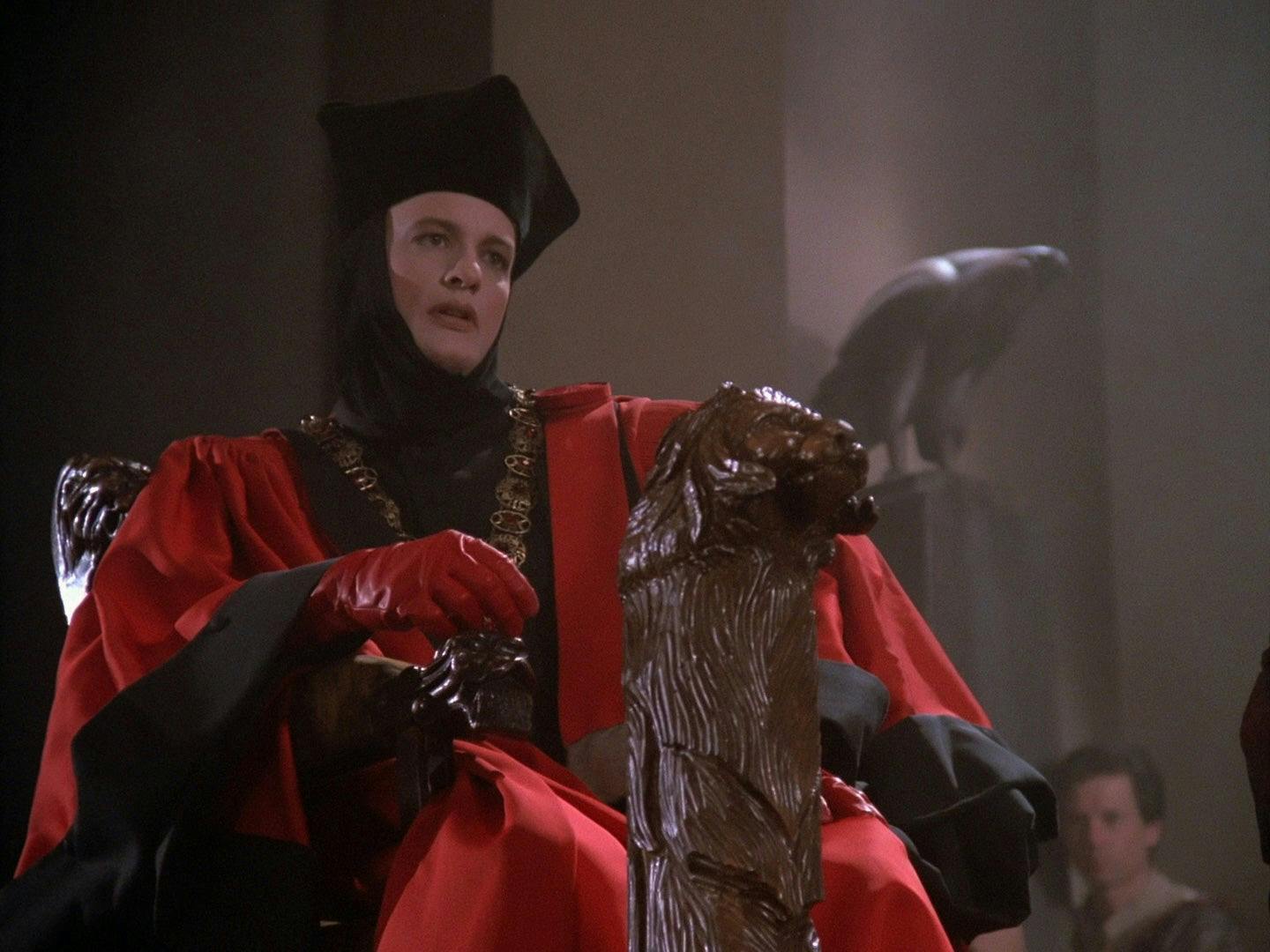 |
| John de Lancie as Q |
The idea is strong. The execution is hesitant.
Character Consistency: Foundations, Not Final Forms
As a pilot, Encounter at Farpoint presents characters who are incomplete rather than inconsistent.
Jean-Luc Picard is stern, distant, and visibly uncomfortable in command. This is often mistaken for mischaracterisation, but in hindsight, it is a deliberate contrast to James Kirk. Picard is not a man driven by instinct or charm; he is reflective, disciplined, and deeply aware of responsibility. His resistance to Q is intellectual rather than physical — he argues rather than postures.
Data emerges as the clearest success. His curiosity, literalism, and desire to understand humanity are fully present from the start, even if the warmth that would later define him is still developing.
Riker occupies an intentional middle ground between eras — confident and capable, but less impulsive than Kirk. Troi and Yar are underwritten, though their narrative functions are clearly established, even if not yet explored.
Crucially, no character behaves in ways that contradict their eventual development. They are sketches, not distortions. The pilot prioritises conceptual integrity over immediate charisma, a decision that pays dividends over time.
Originality of Concept: Putting Humanity on Trial
The episode’s most enduring contribution is Q.
Rather than presenting a traditional antagonist, Encounter at Farpoint introduces a figure who is not interested in conquest, revenge, or power, but judgement. Q does not want to destroy humanity — he wants to examine whether it deserves to continue.
This reframes Star Trek’s optimism. Progress is no longer assumed. Enlightenment is not permanent. Humanity’s moral evolution must be continually proven.
This is a significant shift from The Original Series, where human advancement is largely treated as a settled fact. The Next Generation opens by asking whether that confidence is justified.
The Farpoint alien itself reinforces this idea. Exploitation dressed up as advancement is presented as a moral failure, not a technical one. The solution is not ingenuity, but empathy.
 |
| Visual effects created by ILM Studies for Encounter at Farpoint |
In terms of conceptual ambition, the episode is distinctly and deliberately Star Trek.
Reliance on Special Effects: Ambition Without Dependency
Despite its 1980s visuals and occasional indulgence in slow exterior shots, Encounter at Farpoint does not rely on special effects to hold attention.
The episode’s most important moments are conversational:
-
Picard’s exchanges with Q
-
The ethical realisation behind Farpoint Station
-
Data’s quiet attempts to understand human behaviour
There is no climactic battle, no decisive victory achieved through force. The visual effects serve worldbuilding and tone rather than excitement. If the episode drags, it is due to pacing and exposition, not spectacle.
In an era increasingly dominated by visual excess, this restraint is notable.
Story Versus Spectacle: A Clear Priority
Encounter at Farpoint is unapologetically story-driven.
The resolution comes through understanding, moral clarity, and choice. Humanity is not saved by weapons or strategy, but by recognising injustice and acting to correct it.
This aligns directly with Star Trek’s philosophical roots. The episode trusts that ideas — not action — are enough to sustain interest. That confidence would later waver in parts of the franchise, but here it is firmly intact.
Moving the Franchise Forward: A Philosophical Reset
Perhaps the pilot’s greatest achievement is how clearly it repositions Star Trek.
It establishes that:
-
Exploration includes self-examination
-
The Federation is not beyond moral scrutiny
-
Progress can be superficial if compassion is absent
-
Humanity’s future is conditional, not guaranteed
By framing the series as an ongoing trial rather than a victory lap, Encounter at Farpoint gives The Next Generation a thematic engine that would power its best stories — from ethical debates to political dilemmas and personal responsibility.
This is not simply a continuation of Star Trek. It is a recalibration.
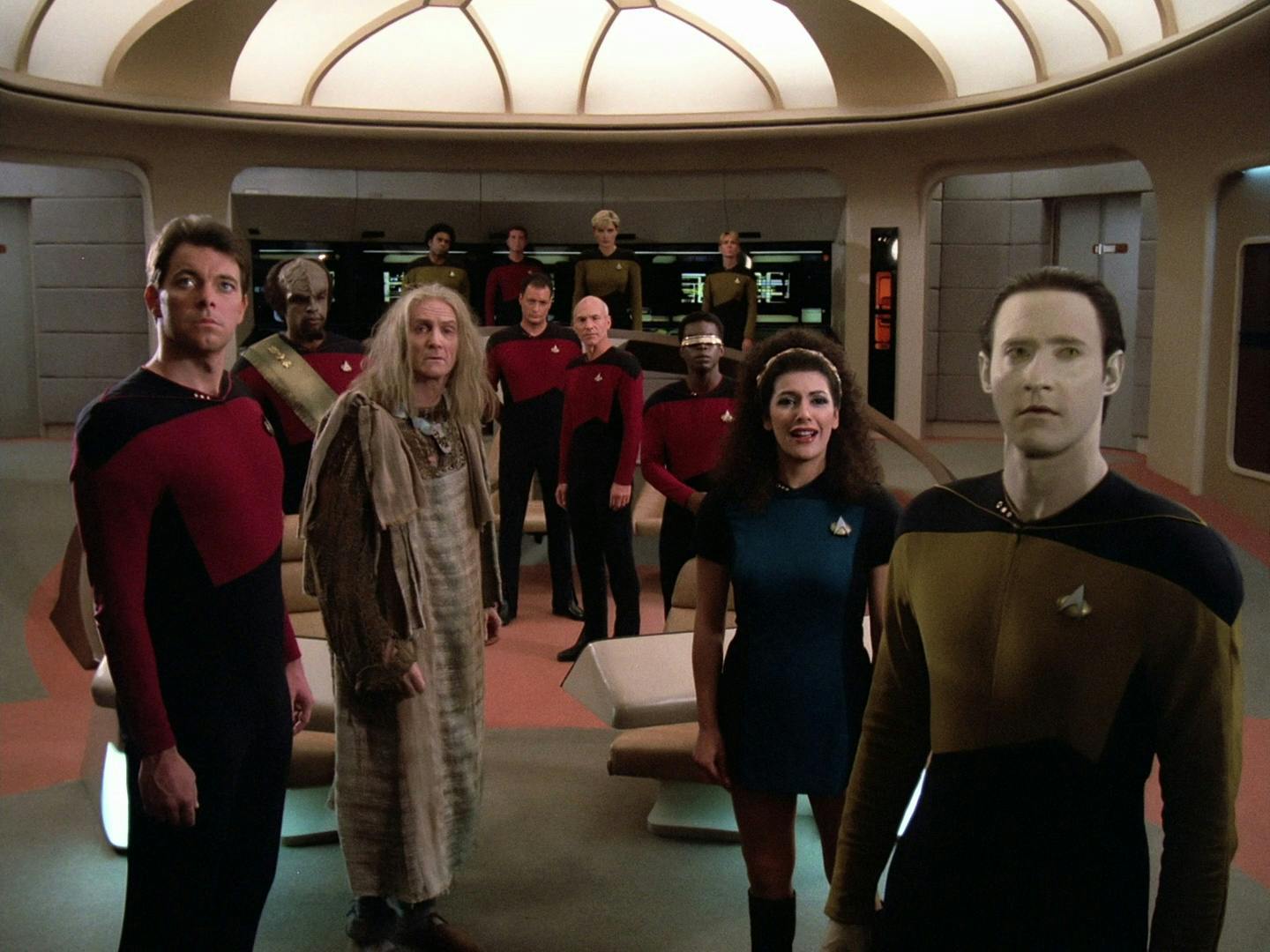
Conclusion: An Imperfect Episode with a Clear Purpose
Encounter at Farpoint is often dismissed as slow, stiff, or dated — and those criticisms are not unfounded. It lacks polish, energy, and narrative economy.
What it does not lack is intent.
It chooses ideas over action, ethics over conflict, and philosophy over spectacle. It understands that Star Trek’s longevity depends not on excitement alone, but on its willingness to ask uncomfortable questions about progress, power, and morality.
As a piece of television, it is flawed.
As a foundation for an era of Star Trek, it is quietly essential.
Most importantly, it remembers something the franchise sometimes forgets:
The story is the point.
No comments:
Post a Comment